A Tallgrass Perspective
Using Atomic Status Transitions to Define the Optimal Pathway and Measure the Dark Matter of Process

Michael Beale, Principal, Tallgrass Solutions
Abstract
Every entity in an operation has a life cycle, and that life cycle contains every outcome the entity can have. The pathway is the route the entity actually took through that space. Most operations measure status as a label, a snapshot of where a thing is today. This paper argues that status should be measured as movement, that the atomic unit of measurement is the single FROM→TO transition, and that when atomic units are stacked in order they form a distinct pathway to a distinct outcome. Once pathways are visible, a single optimal pathway can be defined, every other pathway can be measured against it, and the movements that do not belong to it can be counted, priced and removed.
“Every piece of equipment has one best path through its life.”
Inside this paper
The argument, from first principles to action.
- 01Summary & Conclusions
- 02Introduction
- 03The Atomic Unit and the Grammar
- 04The Optimal Pathway
- 05Core Root Signatures
- 06The Inverse
- 07The Floor
- 08Example — The Switch (the 24-week case study behind the paper’s key chart)
- 09Interpretation and Action
- 10The North Star
- 11Risks
“Dark matter tells us where to look. The Core Customer tells us what to look toward.”
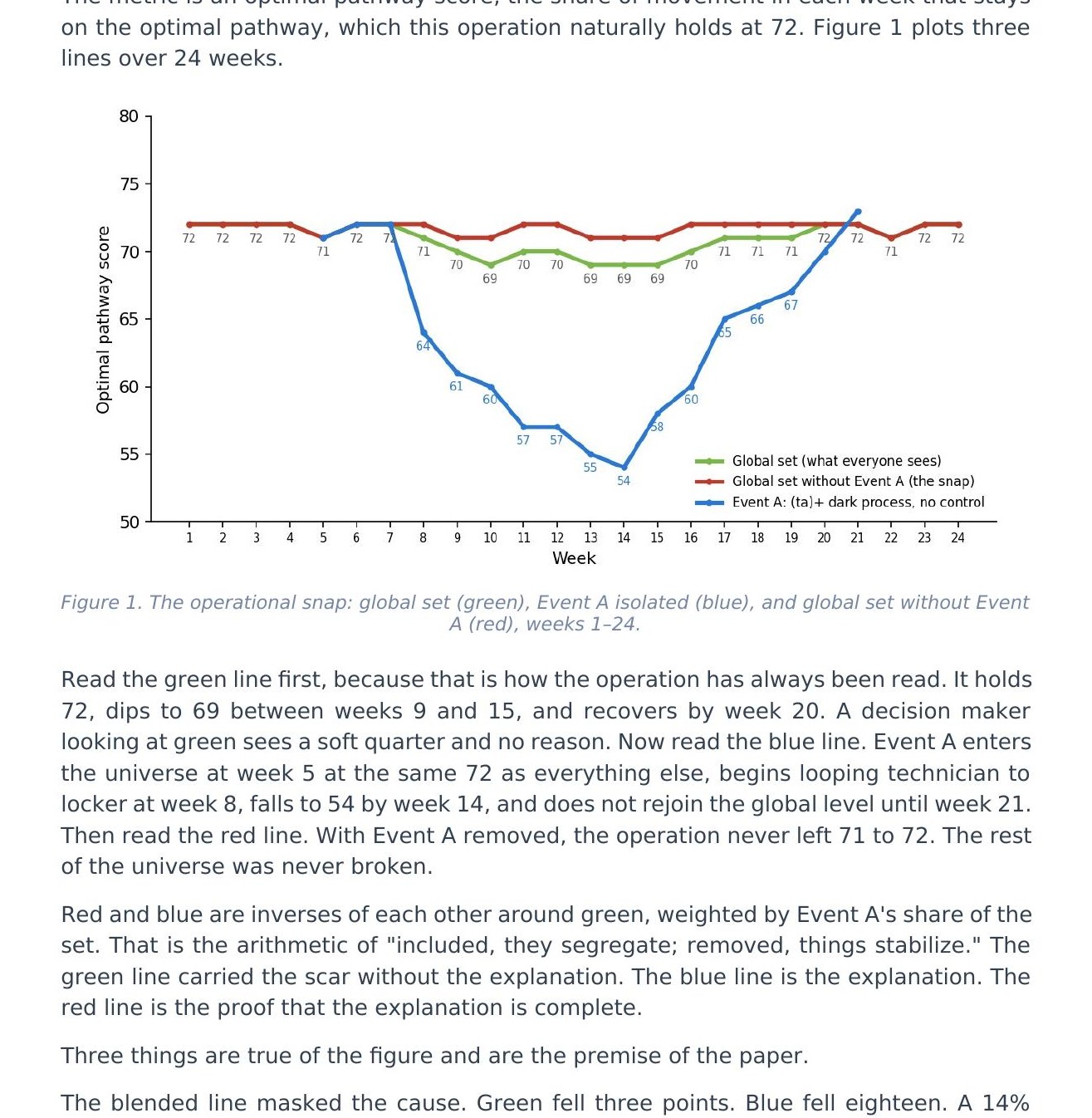
In the paper’s synthetic 300-unit case study, a 14%-of-universe cohort carrying one hidden behavior pattern accounted for 41% of all non-revenue movement — and every one of those units ended in scrap. The full paper shows the chart and the math.
Continue in the full paper
This is the first of two papers. Read the companion piece, The Dark Matter of Governance, on what happens when the cause isn’t in the movement but in the rule.